Exclusive savings on luxury Bhutan tours


The Lotus-Born King: Guru Rinpoche’s Living Legacy in the Kingdom of Bhutan
Explore the sacred legacy of Guru Rinpoche in Bhutan. Learn how the "Second Buddha" transformed the Himalayan landscape, the story behind the Tiger’s Nest, and why his teachings still drive Bhutan’s Gross National Happiness today. Plan your spiritual journey for 2026.
5/8/20242 min read
Introduction
In the high-altitude mists of the Himalayas, Bhutan is often referred to as the "Last Shangri-La." But to the Bhutanese people, it is Beyul—a sacred hidden land blessed by the presence of Guru Rinpoche (Padmasambhava). Known as the "Second Buddha," Guru Rinpoche did not just bring Buddhism to Bhutan in the 8th century; he wove the very fabric of its landscape, culture, and identity.
The Legend: Taming the Himalayan Wilderness
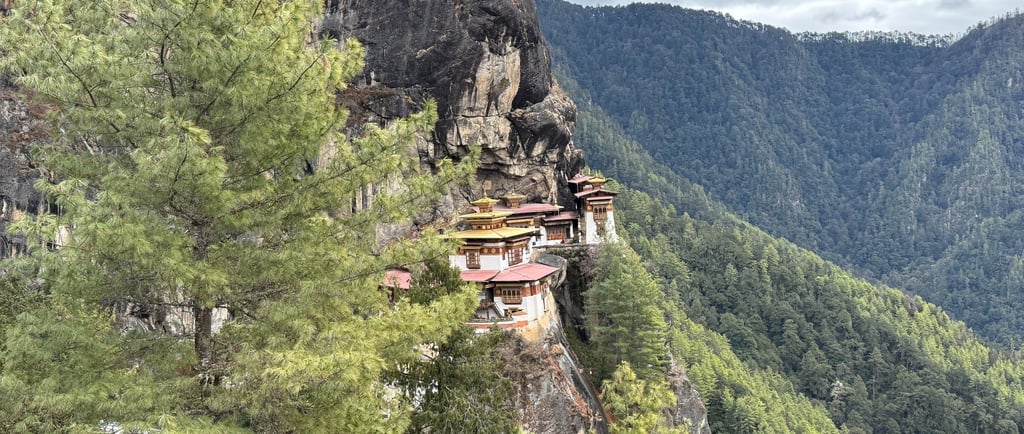
The story of Guru Rinpoche in Bhutan is one of spiritual power and divine transformation. Legend has it that he arrived on the back of a flying tigress to Taktsang (the Tiger’s Nest) to subdue a fierce demon that was haunting the Paro Valley.
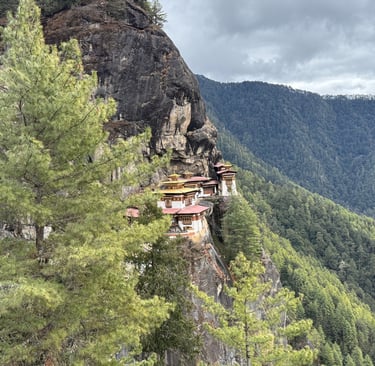
For three months, he meditated in a cave perched 900 meters above the valley floor. His presence was so powerful that it transformed the rugged, wild terrain into a sanctuary of peace. Today, the Tiger's Nest Monastery stands as a testament to this miraculous event, clinging to the cliffside as if held by divine will.
The Sacred Geography: A Land of Body Imprints
Guru Rinpoche’s influence is physically etched into Bhutan’s geography. In the central valley of Bumthang, at the Kurjey Lhakhang temple, visitors can see the "body imprint" of the Guru left on a solid rock wall while he was meditating to heal a dying King.
Throughout Bhutan, there are countless Ney (sacred sites)—caves, rocks, and waterfalls—where the Guru left footprints or hidden treasures (Terma) intended to be discovered by future generations. To travel through Bhutan is to walk through a spiritual map drawn by the Guru himself.
The Soul of the People: Happiness as a Spiritual Path
The relationship between Guru Rinpoche and the Bhutanese people goes beyond history; it is a living connection. The vibrant Tshechu festivals (like the ones coming in 2026) are dedicated entirely to his eight manifestations. The masked dances (Cham) are not merely performances; they are visual meditations that cleanse the soul and remind the people of the Guru's teachings on compassion and wisdom.
The famous Bhutanese "Gross National Happiness" finds its roots here. Guru Rinpoche taught that the environment is sacred and that all sentient beings deserve kindness. This ancient wisdom is why Bhutan remains one of the world's most ecologically pristine and culturally intact nations today.
Conclusion: Journey to the Heart of the Himalayas
Visiting Bhutan is more than a vacation; it is a pilgrimage into a world where the spiritual and the physical are one. Whether you are trekking to the Tiger’s Nest or witnessing the kaleidoscope of a Tshechu festival, you are experiencing the enduring legacy of the Lotus-Born Guru.
At Authentic Bhutan, we invite you to explore this sacred heritage. Join us for our 2026 Signature Journeys and discover the land where legends live.
Contact
Reach out for your bespoke Bhutan journey
Phone
Tel: +1.936.325.9999
© 2025. All rights reserved.
Whatsapp: +1.936.325.9999